Why the reform is operational, not just legal
The Tax Reform began as a legal and fiscal discussion. But for those running B2B e-commerce, it is a series of changes that land directly at checkout. Your ERP will be tested. Your tax calculation engine may need to run two systems in parallel for years. Your cash flow may change with Split Payment.
The mistake of treating it only as compliance
Many B2B companies are waiting for the legal team to “solve” the reform. Consulting, conformity, audit. Meanwhile, operations stay frozen. What tends to make a difference in the market is not just being compliant, it is being prepared to calculate taxes in real time with two systems in parallel, iterating when rules change and keeping a predictable tax engine.
What changes at B2B checkout at each milestone
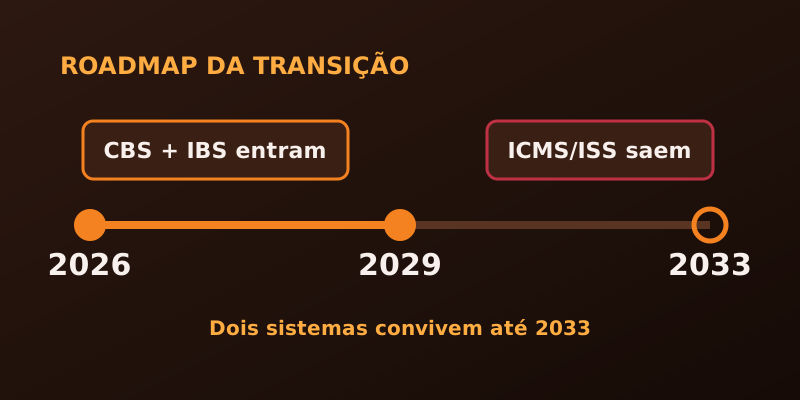
The LC 214/2025 timeline has relevant milestones through 2033. Each one may trigger changes at the checkout, in accounting, in cash flow and in commercial terms. The question is not only being compliant in 2033, it is being operational at every milestone that arrives, because every delay can cost market share.
The 2026 to 2033 timeline milestones
The main regulatory framework for Brazil’s Consumption Tax Reform is LC 214/2025, which regulates EC 132/2023. The milestones below follow the transition timeline set in LC 214/2025. For your specific scenario, validate with a qualified professional.
2026: test rates for CBS and IBS
2026 is the year of test rates, with CBS at 0.9% and IBS at 0.1%, per the LC 214/2025 timeline. For B2B operations, this is the moment to start internal dual calculation tests, validate ERP integration and prepare commercial teams for different tax treatments by region.
Risk of not doing it: the commercial team keeps offering prices based on ICMS logic, when the system should already be testing scenarios with IBS and CBS.
2027: CBS replaces PIS and COFINS, and IS goes live
In 2027, CBS (Contribution on Goods and Services) replaces PIS and COFINS, and the Selective Tax (IS) on products harmful to health or the environment takes effect. Between 2027 and 2028, your B2B operation will run CBS alongside ICMS, ISS and other remaining taxes during the transition.
The tax engine must be operational for CBS in January 2027. Errors may generate overpaid taxes, incorrect accounting entries and exposure during Federal Revenue (RFB) audits.
2029 to 2032: ICMS and ISS transition into IBS
Between 2029 and 2032 the progressive transition of ICMS and ISS into IBS takes place, with a phased reduction of the old taxes and a gradual increase in IBS. This is the period where most of the market moves. Those running a robust tax engine tend to offer more predictable prices. Those who cannot migrate from ICMS in a controlled way may fall behind.
2033: full IBS and CBS regime
End of the transition. Calculations run mostly on IBS and CBS, with ICMS and ISS phased out. Any configuration error at this stage may turn into a meaningful tax liability.
What each milestone requires from B2B operations
You cannot ask a CFO, a Head of E-commerce and a CTO to prepare for the reform in the same way. Each one needs a specific checklist.
Decisions for the CFO
- 2026: start simulating the financial impact of Split Payment. How much working capital may be affected? Do you need additional bank credit? When?
- 2026 (test phase): validate Split Payment pilots. Test with one product, one region, one large account. Measure the real impact of withholding.
- 2027: financial decision on tax prepayment. The dual flow of CBS plus remaining taxes will demand more sophisticated tax planning. Do you need a specialist?
- 2029: review banking covenants if needed. The transition may temporarily affect financial ratios.
Decisions for the Head of E-commerce
- 2026: start pricing tests with dual calculation. Are prices correct under the dual regime? Are they competitive?
- 2026 (Split Payment tests): test with a customer segment. What is the experience? Does the customer notice a difference?
- 2027: be ready for different tax treatments in the catalog. Some products may have different rates. Does the store support that?
- 2029 to 2032: turn capability into competitive advantage. If the tax engine is stable, use it commercially.
Decisions for the CTO
- 2026: integration of a complementary tax engine to the ERP in a test environment, with dual IBS and CBS calculations under validation.
- 2026 (Split Payment): APIs prepared for the withholding mechanics as regulation advances. Each transaction needs tax withholding logic when that phase takes effect.
- 2027: tax engine in production with CBS replacing PIS and COFINS. High uptime target. Calculation errors may generate exposure with RFB.
- 2029: migrate ICMS to IBS in the engine. Critical operation. The dual system must be mature enough so that the change is nearly transparent.
How the Mastery tax engine operates in dual mode
Running two simultaneous tax systems at checkout is not theoretical, it is architecture. Mastery, in operation since March 2025, maintains the Syntax engine in dual mode in its internal environment, tracking the LC 214/2025 milestones.
Coexistence of IBS, CBS and legacy taxes at checkout
While ICMS, ISS, CBS and IBS coexist, each transaction may need to calculate multiple taxes. It is not “calculate ICMS, then CBS, and sum.” It is knowing which rate applies, at which point of the flow, and ensuring the final result is auditable. The Syntax engine runs those calculations in parallel, logs each separately and returns to the checkout a final auditable number for the invoice.
The customer sees a single price on the storefront. The engine internally identifies which taxation applies. If a rule changes, the engine updates the configuration.
Real-time calculation with multiple systems
Running more than one system does not necessarily mean high latency. The Syntax engine has a latency target under 100ms in production, including scenarios with ICMS-ST, DIFAL and Selective Tax. Specific SLAs are defined case by case in the contract.
Dual logging and auditing
Each calculation is recorded in two layers. One for tax invoice issuance (the one that goes to NF-e). Another for internal audit (error tracking and compliance). In a potential RFB audit, you have the full history of the rule in force at the time of calculation.
Operational checklist: what to validate now
Here is what to validate today to avoid surprises in 2027.
- Is a complementary tax engine already integrated with your ERP? If the answer is “we will integrate,” start now. Mastery setup typically takes around 10 business days (observed average, varies by integration and SKU volume).
- Has Split Payment already been simulated for financial impact? Does the CFO know how much capital may leave the flow? Have the banks been contacted?
- Are commercial teams trained on dual tax logic? B2B pricing will be more complex.
- Is the compliance checkpoint audited? Do you have a tax audit that validates calculations?
- Customer communication plan in place? The B2B customer does not always understand taxation, but does understand “your price will change in 2027.”
- Is a tax specialist engaged to validate technical interpretation of rules as they are published?
- Is the test environment cloned from production? Testing in dev can be misleading. Clone production (with anonymized data) and validate there.
- Pricing review agenda set for the critical LC 214/2025 milestones?
- Tax flow documentation mapped? What is the flow today? Draw it. Then draw the dual flow.
- Contact with the tax engine vendor scheduled?
- Tax error KPI defined? Do you track what percentage of orders have calculation errors?
- Plan B for contingency? If the tax engine fails, what is the plan to still get orders out?
The cost of not preparing: illustrative simulation by size
The numbers below are an illustrative simulation based on hypothetical assumptions. They are not proven statistics nor guaranteed projections. They vary by tax regime, margin, product mix, real financial cycle and operational maturity.
Small operation (BRL 5M per year in B2B) - Implementation delay cost: estimated range of BRL 50k to BRL 150k (tax consultant time, fiscal consulting, invoice rework). - Liability risk: estimated range of BRL 80k to BRL 400k (miscalculated taxes over 12 months, interest and fines). - Opportunity cost: estimated BRL 200k (margin lost by not offering competitive prices in the new regime). - Illustrative total for 12 months of delay: BRL 330k to BRL 550k.
Medium operation (BRL 30M per year in B2B) - Delay cost: BRL 300k to BRL 600k (dedicated team, consulting). - Liability risk: BRL 600k to BRL 2M (errors at greater volume). - Opportunity cost: estimated BRL 1.5M (larger customers may prefer prepared suppliers). - Illustrative total: BRL 2.4M to BRL 3.2M.
Large operation (BRL 150M per year in B2B) - Delay cost: BRL 1.5M to BRL 3M. - Liability risk: BRL 4M to BRL 15M. - Opportunity cost: BRL 8M to BRL 20M. - Illustrative total: BRL 13.5M to BRL 38M.
The simulation is not panic, it is a math exercise on the cost of being unprepared inside a calendar defined by law.
Frequently asked questions
Does the Tax Reform apply to B2B e-commerce?
Yes. The reform is about the tax flow, not the sales channel. If you sell a product or service to companies (CNPJ) and use digital checkout, the reform applies in full. Rules may vary by state (UF), regime, NCM and operation. Consult a tax specialist for your specific case.
What changes at B2B checkout in 2027?
In 2027, CBS replaces PIS and COFINS and the Selective Tax goes into effect. From that milestone on, each calculation must consider CBS, ICMS, ISS and IS where applicable. Calculation logic changes, invoice issuance changes and price may change depending on the product and the operation.
Do I need to replace my ERP because of the reform?
Not necessarily. The ERP keeps doing what it does well: inventory, finance, logistics. What changes is the taxation layer at checkout. A complementary tax engine can sit between the ERP and the e-commerce, handling the tax intelligence without altering the ERP.
How do I calculate IBS and CBS in real time at the cart?
You need a tax engine that knows the rules for IBS, CBS, ICMS-ST, DIFAL and specific rates. It must be a system, not a spreadsheet. The engine exposes an API that the checkout calls every time an item is added.
How long does it take to prepare a B2B operation for the reform?
If you already have an integrated tax engine and aligned teams, 2 to 3 months of preparation is a reasonable estimate. Starting from scratch, 4 to 6 months (engine integration, testing, validation). These timelines vary significantly by installed base and migration complexity.
This content is informational and does not replace specialized accounting, tax, or legal advice. Brazilian tax rules may vary by state (UF), tax regime, operation, product, NCM code, CNAE, and buyer profile. Validate your scenario with a qualified professional.
Next step: Free readiness diagnostic for the Tax Reform
Related reading: - How to prepare your B2B e-commerce for IBS/CBS without rebuilding the ERP - IBS and CBS at B2B checkout: how dual mode works in production - Split Payment and working capital: the invisible impact on digital distributors - Mastery technology - Customer cases